Cancelations: Overview
Last updated: March 19, 2026
NOTE: This article covers cancelations for agency-billed and premium-financed policies on Ascend. For MGA-specific cancelation workflows, please refer to Cancelations, Refunds, and Reinstatement
This guide will teach you:
What a cancelation is and the types Ascend handles
How Ascend processes voluntary (insured-requested) cancelations
How Ascend processes non-pay cancelations
How Ascend processes flat cancelations
What return premium (RP) and return commission (RP) are
Overview:
A cancelation occurs when an insurance policy is terminated before its expiration date. When a policy is canceled, any unearned premium and return commission must be returned to the active loan balance and then the excess to the Insured. If there is no loan balance, it is sent directly to your client.
Ascend handles different types of cancelations:
1. Voluntary Cancelation (Insured Request)
The insured requests cancelation from the agency, which then processes it in Ascend after receiving confirmation from the carrier, wholesaler, or MGA.
2. Non-Pay Cancelation
Ascend cancels a financed policy due to non-payment of installments and sends Notices of Cancelation (NOCs) to the insured and billing company on the agency's behalf.
3. Flat Cancelation
A cancelation where the full return premium and return commission are returned, with no proration. Flat cancelations are only eligible within 60 days of the effective date, and require the full RP and RC to be returned. If only partial funds come back, the cancelation is treated as a regular cancelation instead.
How Cancelations Work:
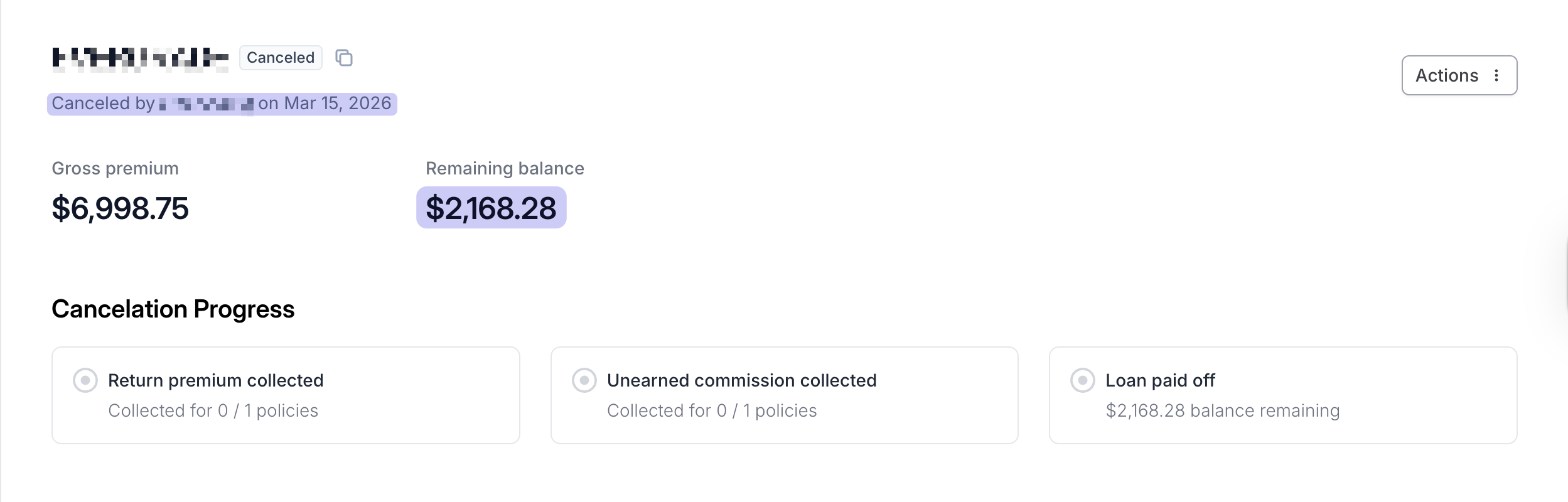
Voluntary Cancelation Flow
The agency cancels the policy with the carrier/wholesaler/MGA.
The agency cancels the program in Ascend.
Future invoices are voided automatically.
The carrier, wholesaler, or MGA sends a cancellation invoice to the agency.
Return premium (RP) and return commission (RC) collection begins.
For detailed instructions for how to process a cancelation request in Ascend, please see: [Cancelations: Initiating a Cancelation →]
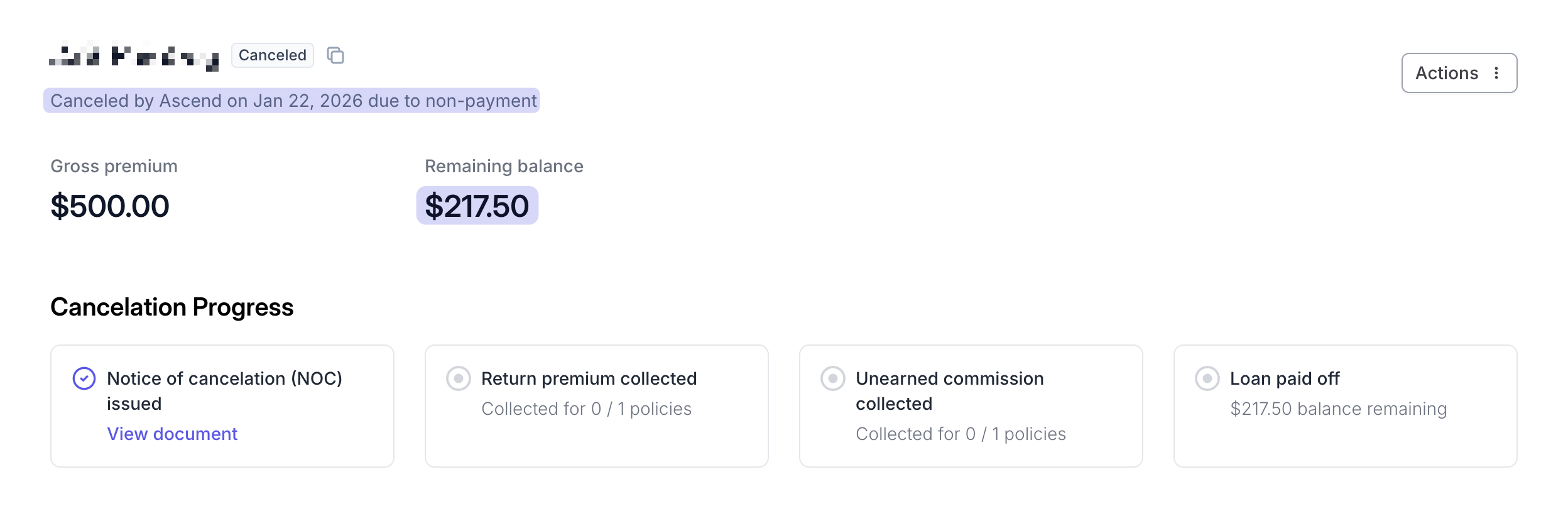
Non-Pay Cancelation Flow
The insured misses an installment payment.
A late fee is applied to the account.
A Notice of Intent to Cancel (NOIC) is issued to the insured, giving them an opportunity to bring the account current before cancelation proceeds.
If payment is not received, a Notice of Cancelation (NOC) is issued to the insured and the Carrier/MGA.
Ascend cancels the program and voids future invoices.
The Carrier/MGA receives the NOC and processes the cancelation.
The Carrier/MGA sends a cancelation endorsement and invoice to the agency.
Return premium (RP) and return commission (RC) collection begins.
For a full breakdown of late fee timing, NOIC issuance, and NOC deadlines, see: [Late Fees, NOICs & NOCs Timeline →]
For detailed instructions for how to process a cancelation request in Ascend, please see: [Cancelations: Initiating a Cancelation →]
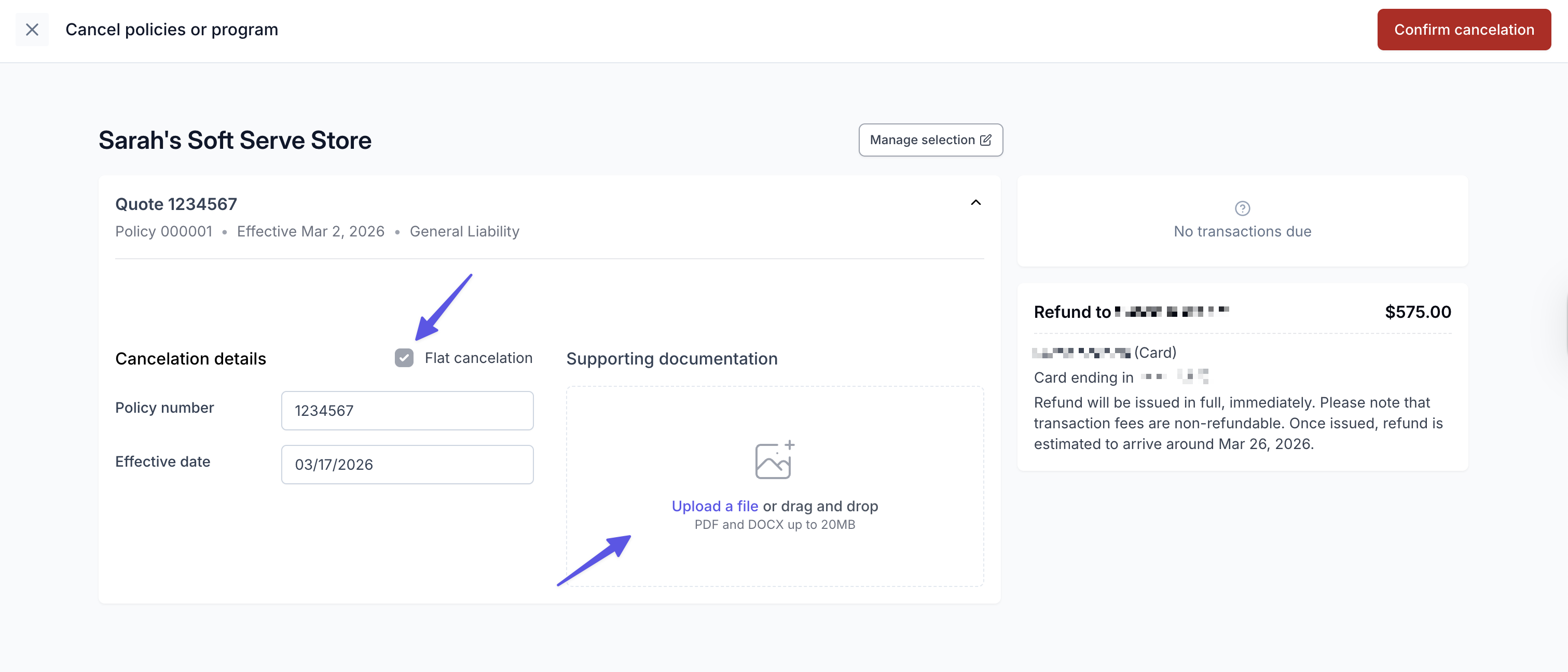
Flat Cancelation Flow
The agency confirms the policy was canceled within 60 days of the effective date.
The agency cancels the program in Ascend.
Future invoices are voided automatically.
The carrier, wholesaler, or MGA returns the full return premium and return commission to Ascend, with no proration applied.
Ascend closes the loan, voids any financing charges, and issues a full refund (less any transaction fees) to the insured.
For detailed instructions for how to process a cancelation request in Ascend, please see: [Cancelations: Initiating a Cancelation →]
Return Premium (RP) and Return Commission (RC)
Note: The terms "return commission" and "unearned commission" are used interchangeably.
When a policy is canceled, two types of funds need to be returned. Ascend tracks both separately so you always have a clear picture of what's been received and what's still outstanding.
Term | Definition |
Return Premium (RP) | Unearned premium the carrier owes back for the unused portion of the policy term |
Return Commission (RC) / Unearned Commission (UEC) | Unearned commission the agency owes back for the unearned portion of the policy term |
Frequently Asked Questions
Q: What happens to my insured's future invoices when a policy is canceled?
All future invoices are voided automatically when a cancelation is initiated in Ascend.
Q: Does the loan keep accruing interest after a policy is canceled?
Yes — for financed policies, the loan stays open and interest continues to accrue until the loan balance reaches $0. Returning RP and RC promptly helps minimize those costs for your insured.
Q: Who sends the Notice of Cancelation (NOC)?
For non-pay cancelations, Ascend sends NOCs to the insured and the carrier/wholesaler/MGA.
Q: How do I know when my client's refund will be issued?
Refunds are processed after all funds (RP and RC) are collected and the loan balance is cleared. See our [Refunds →] article for timeline details.
Q: Can Ascend backdate a cancelation?
No — Ascend is required to use the same cancelation effective date for the client’s policy as the carrier.
Q: Is interest always calculated pro-rata on a cancelation?
No, some states do not legally require interest to be canceled pro-rata.
Q: Can I reinstate a canceled policy?
Yes, canceled policies can be reinstated under most circumstances. For more information, visit our article on Reinstatements →.
Need more help? Contact us at [email protected].